Pharmacy Design
Design? What for?!
What to consider when fitting out a pharmacy
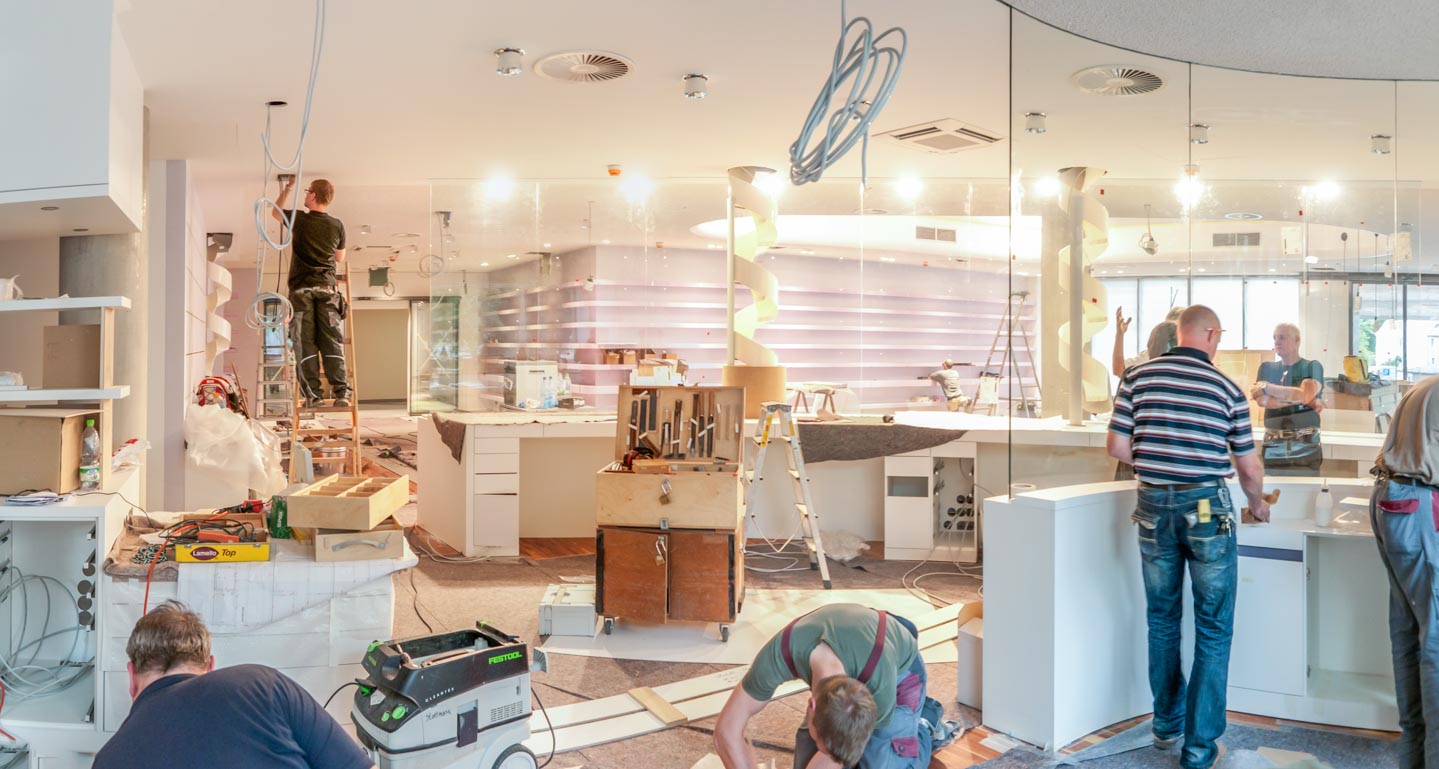
Saale Clinic Pharmacy in Halle, photographed during construction.
The pharmacy interiors on this site span more than three decades of our work. Take a short journey back in time or explore the projects on the map and judge for yourself how the design has changed and how well the interiors have aged. You can certainly see something of the period in which each one was made. We have always wanted to design interiors that age gracefully.
In our carefully composed project photographs, we want to show our own work, with as little Ratiopharm and Vichy as possible. This time, we thought we would show a bit of real life.
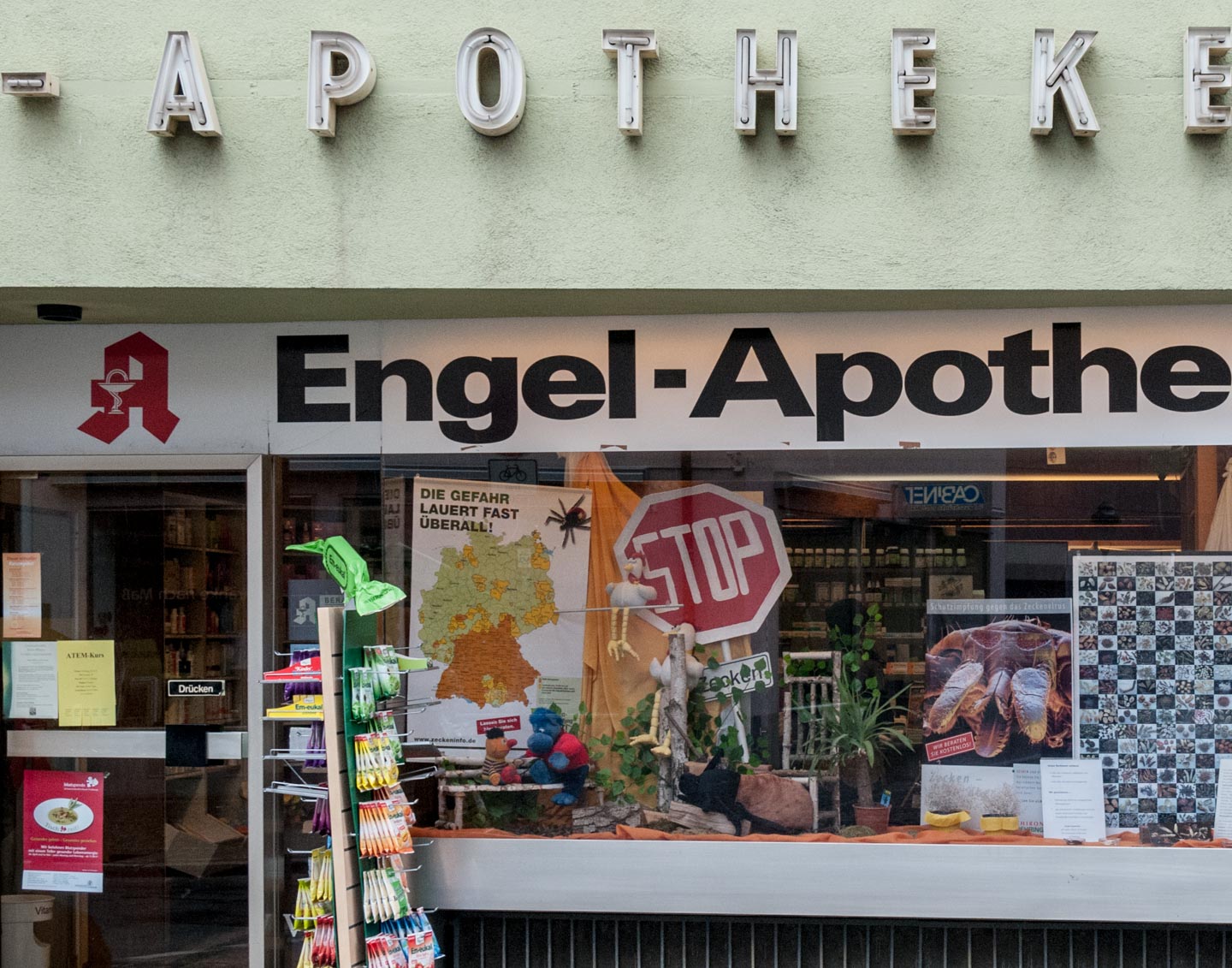
The façade of Engel Pharmacy before the refurbishment. See what became of it.
Why bother designing a pharmacy? People will come anyway!
People come because they have to. It is much the same with petrol stations. If the operator could make a living from selling fuel alone, the appearance of the place would hardly matter. It would be enough to give the impression that the petrol had not been watered down and the pumps were unlikely to explode at any moment. How do you feel now, picturing that nightmare of a petrol station?
The first thing at stake is trust. And however sentimental it may sound, that calls for love. For yourself, for the place around you and for the work you do. In the health professions, you spend every day with people who have a problem. If you can speak to them with warmth, competence and honesty, you earn their trust. That is hard work.
Design is often used to give a false impression of trustworthiness and has, in many places, become a clever little trick of form. By now, every consumer knows to expect this sort of deception. Little wonder distrust has become part of everyday commerce.
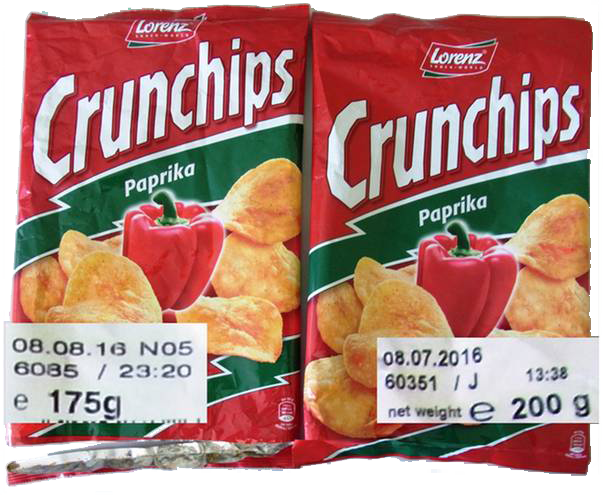
Deceptive packaging
Crisps with a “new look”. Twice the size of bag and twice as much air.
People will still come. For the pharmacist, design offers a way to express their personality and professional interests. That can help create a place where the pharmacist, the team and customers who are already having a difficult day can all feel at ease and trust one another.
What are the trends and which colours are in fashion?
Trends and fashion are largely marketing. Take the word “sustainability”. What does sustainability have to do with fashion, which changes all the time? An interior in this year’s fashionable colours can look dated in a few years. Think of those kitchens with high-gloss doors.
Sustainability means using the materials and resources available to us responsibly
In modern shopfitting, the usual cycle is just five to seven years. Every few years, a new fit-out and a new experience. The Town Pharmacy in Achern had already been working for more than three decades. Once the refurbishment had paid for itself, the furniture still looked new and everything worked for another twenty years. Then the pharmacist retired. A successor was soon found and proudly took the pharmacy into its fourth decade. A business can be doing well on paper, but the prospect of a six-figure bill for overdue work can still deter a buyer.
That colour is a bit too modern for me …
Colours become fashionable through the way they are combined with other colours and shapes. Take blue jeans. They have been around since 1872, and indigo has been their colour from the start. Is the colour fashionable? Has the fabric ever gone out of fashion? Over the past 150 years we have had skinny jeans, flares, bootcuts, high waists, holes and thick stitching. Jeans themselves have never gone out of fashion. Neither has a green meadow, a blue sky, autumn leaves or ripe, dark red cherries.
Colour does a great deal of work. It carries a company’s identity and its marketing. In Germany, everyone knows which telecoms company is magenta and which parcel service is yellow. In politics, people readily speak of black, red and green. Colours also stir emotions and shape the atmosphere of a room. Much of that atmosphere comes from how colour, light and texture meet.

Denim
“Purple is hardly harmless.”
“Why?”
“Women kill themselves on purple sofas … single women.”
“In Turin a footballer shot himself on his sofa. But that one was yellow.”
(Loriot, Ödipussi)
Read more about colour and its effects.
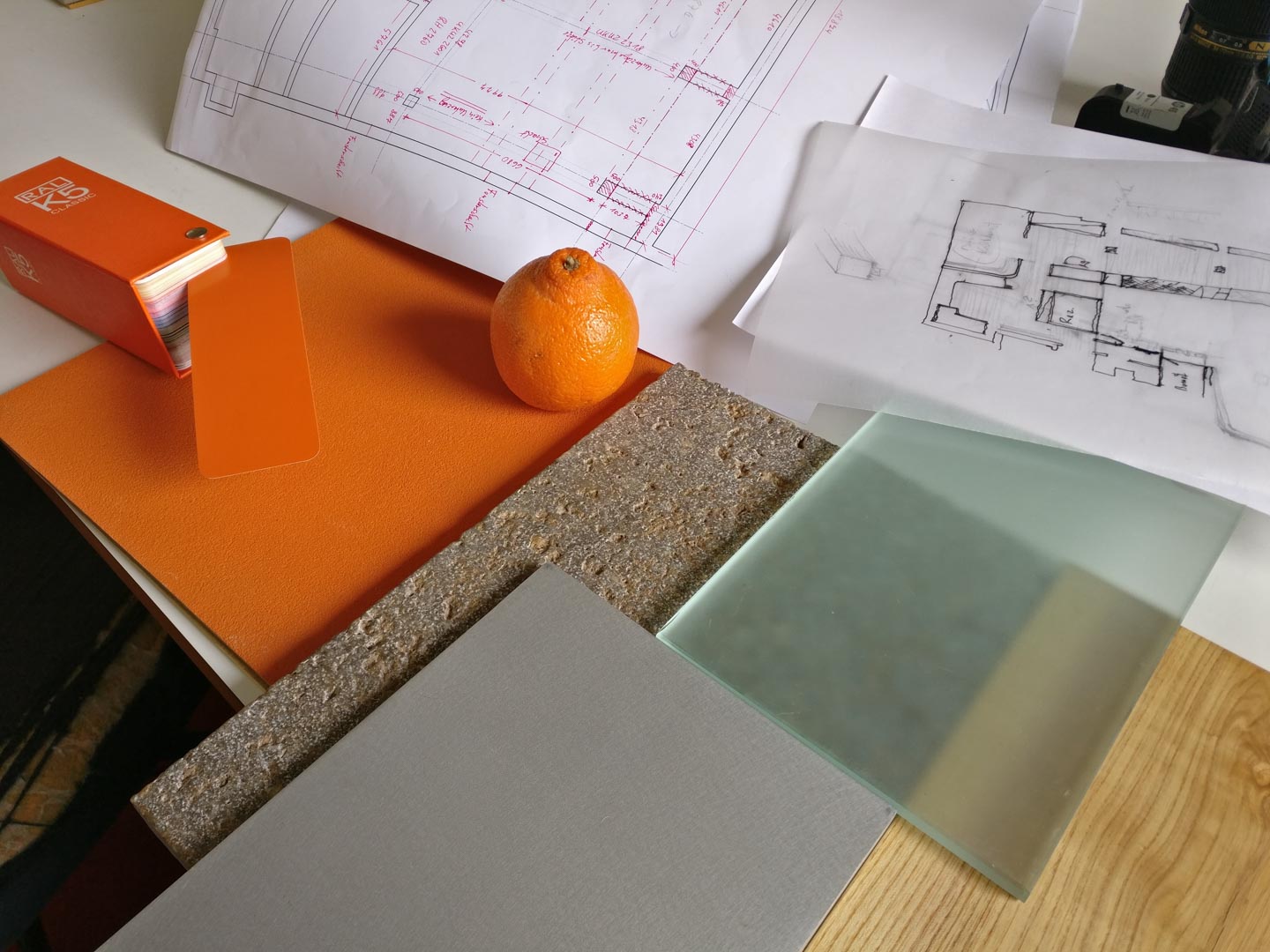
Material palette for the Town Pharmacy in Cologne
Which materials do we favour today?
Wood, stone, metal and glass. For as long as people have built things, they have used what was available around them. A material should be able to age well and still have character when it is worn. We call that patina. Materials can delight us with a richness that we can both see and feel. Durability and resistance to wear matter, and so does hygiene. This is where modern composite materials and antibacterial coatings come in. Materials such as clay plaster are also gaining ground. Where possible, we work with materials and methods rooted in the region. Every place has an identity of its own.
What should a pharmacy interior do today?
A pharmacy interior, like anything else, is more than the sum of its parts. It has to feel right for customers and pharmacists alike. A customer who is already feeling unwell usually wants one thing. “Get in, get out and get straight back to bed.” The chilly atmosphere of many surgeries and pharmacies does little to discourage that impulse. Given the choice, people stay away. A pharmacy interior needs efficient working routines that can cope with growth. It also needs to show the pharmacist’s strengths, expertise and personality, and make customers feel welcome, well advised and willing to buy something and come back. When someone receives genuine attention and care, a kind of attachment to the business can grow. It is a bit like a blind date with a pharmacy. First impressions matter.
The Pharmacy Dispensing Counter
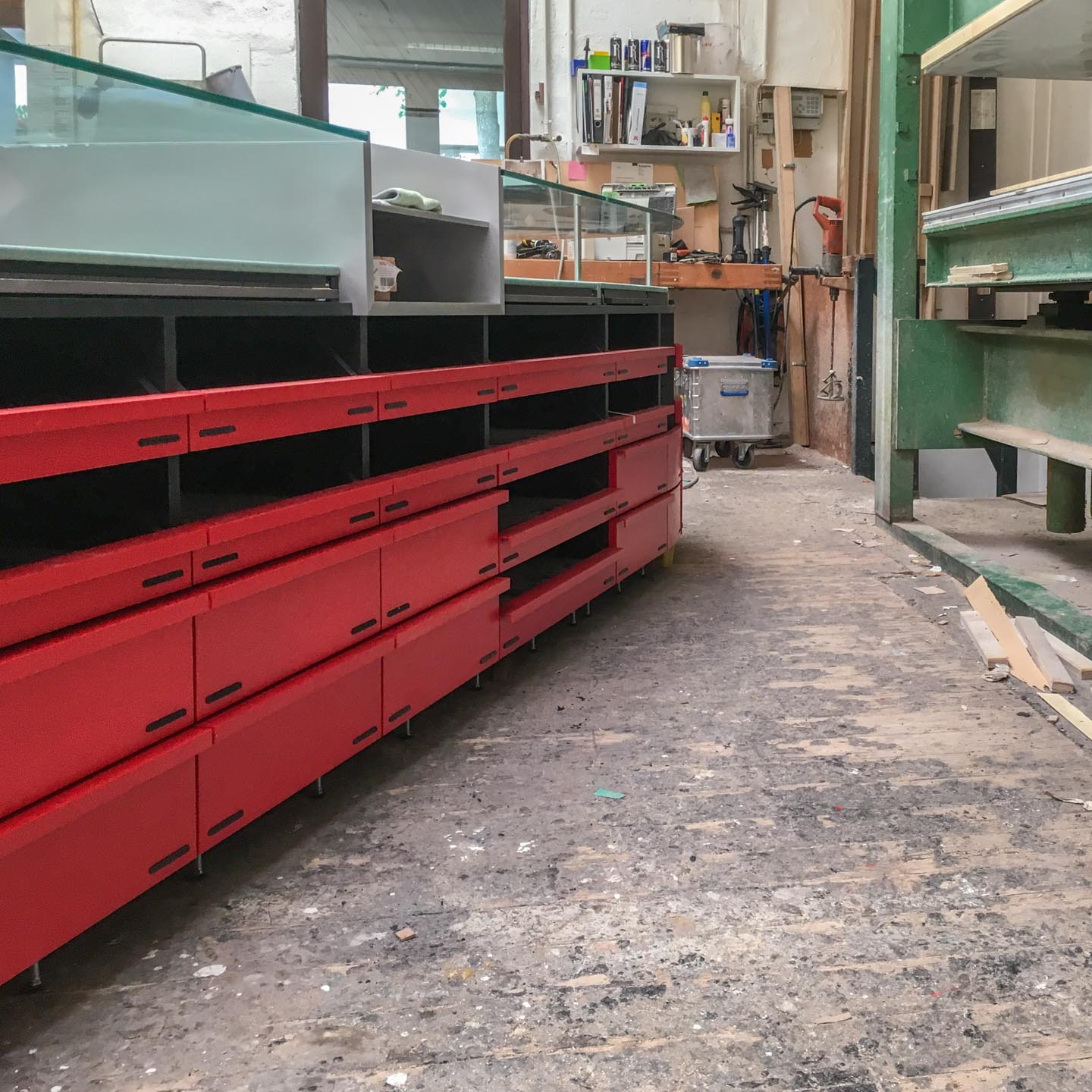
The dispensing counter is where pharmacist and customer meet. We always give it particular attention.
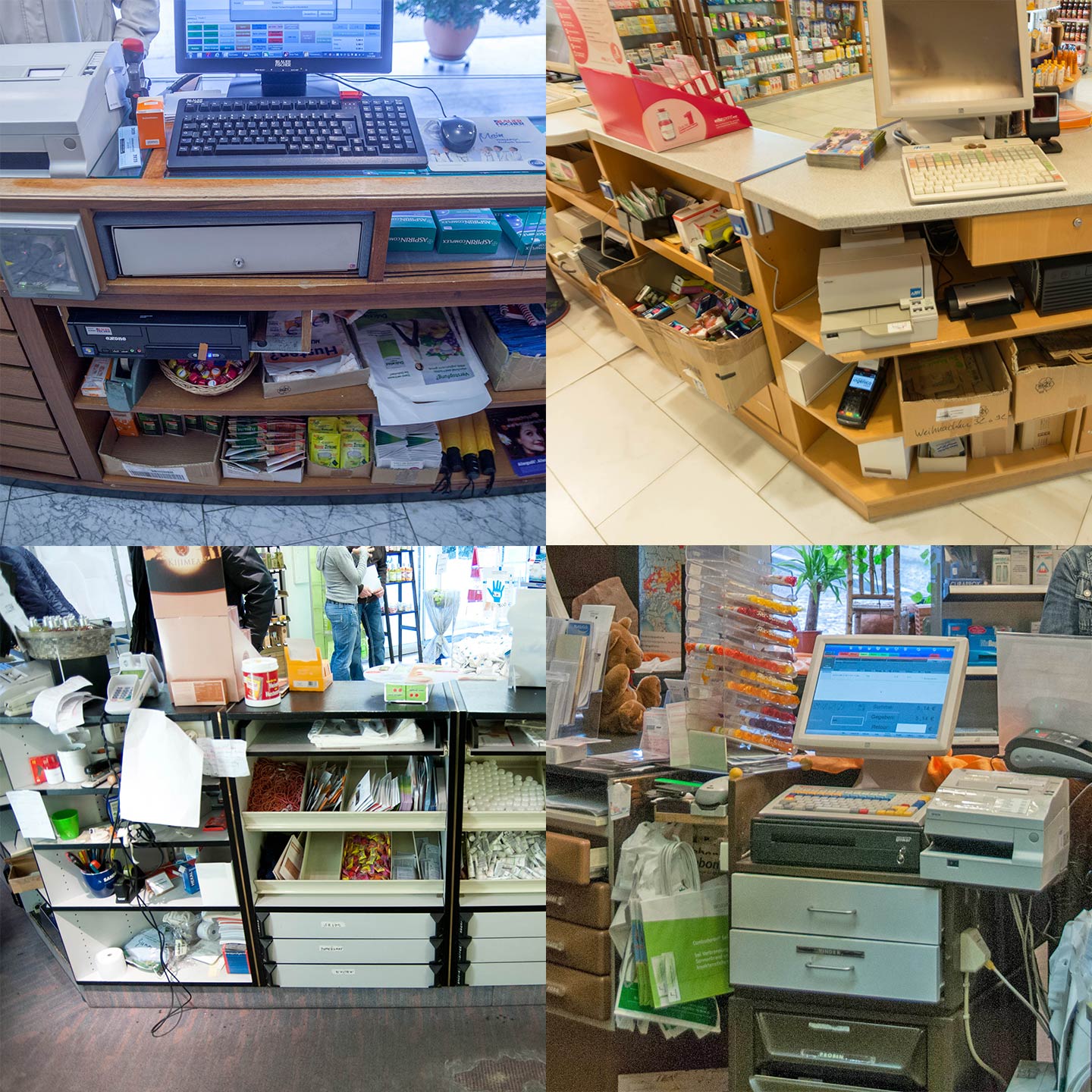
Existing dispensing counters
All too often, this is what the staff side looks like. There are no drawers, let alone dividers. Instead, plain shelves hold assorted cardboard boxes. Then, over the years, came the computer, receipt and prescription printers, barcode scanner and cash drawer. In some cases, fitting in the printer alone stretched what the existing counter could accommodate. The dispensing counter, like the till, is a tool. It has to work properly and look orderly behind the scenes as well.
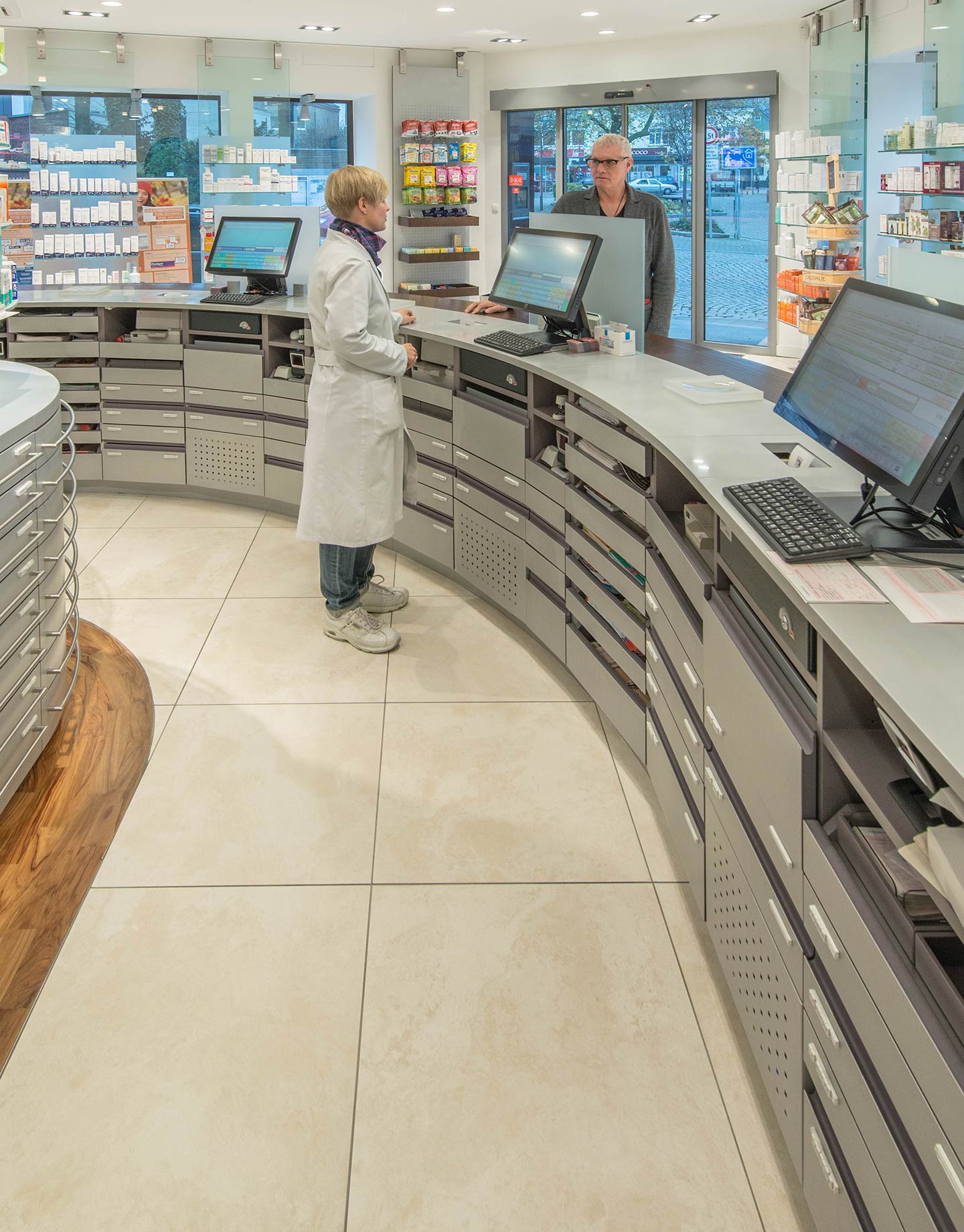
A photograph from everyday practice. This dispensing counter looks good from the back too. The fronts are grey-tinted MDF faced with 2 mm solid aluminium sheet.
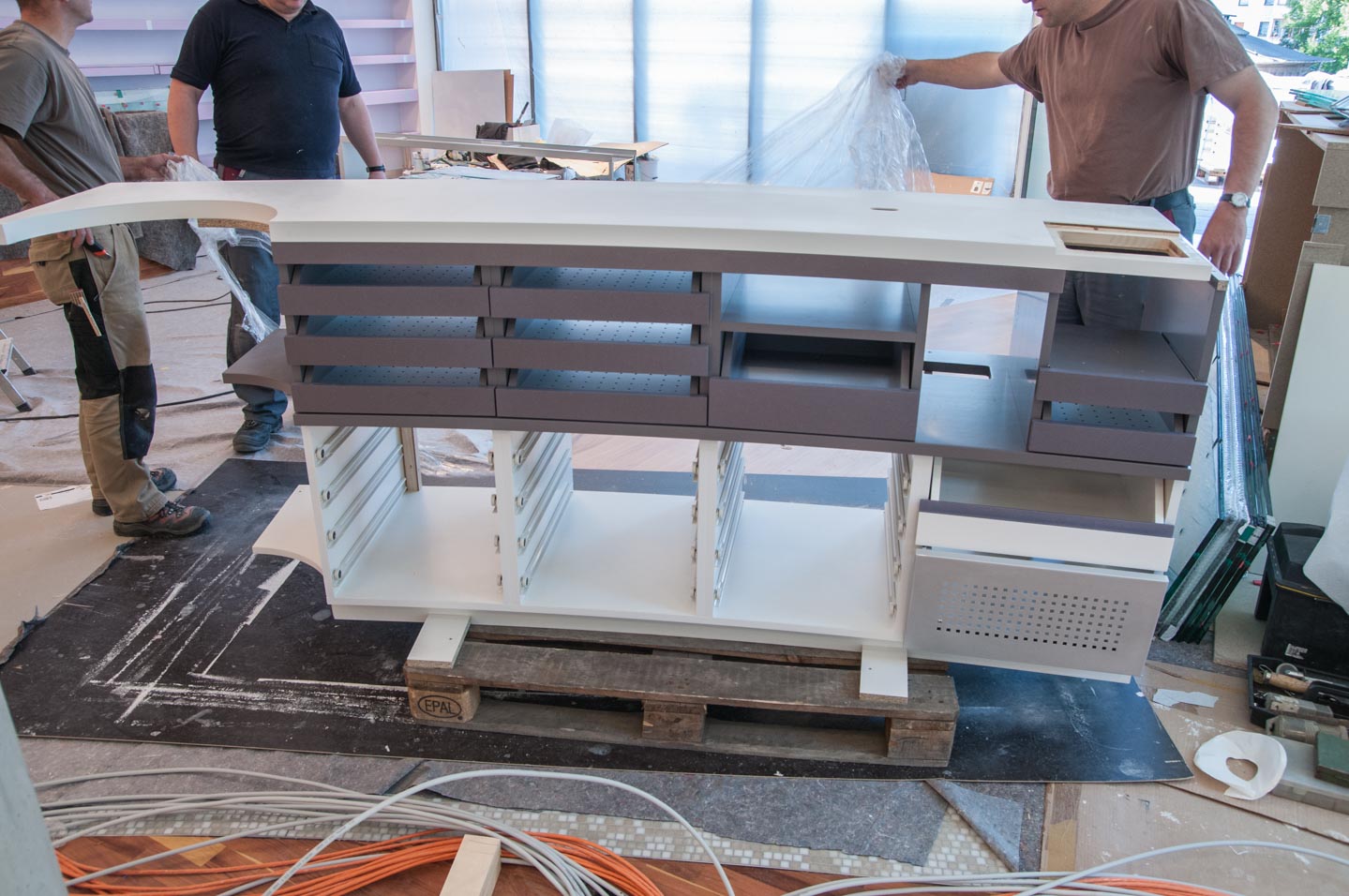
These photographs were taken on site at Saale Clinic Pharmacy. The dispensing counter is being assembled. You can see the many pull-outs inside and the space set aside to conceal the cabling.
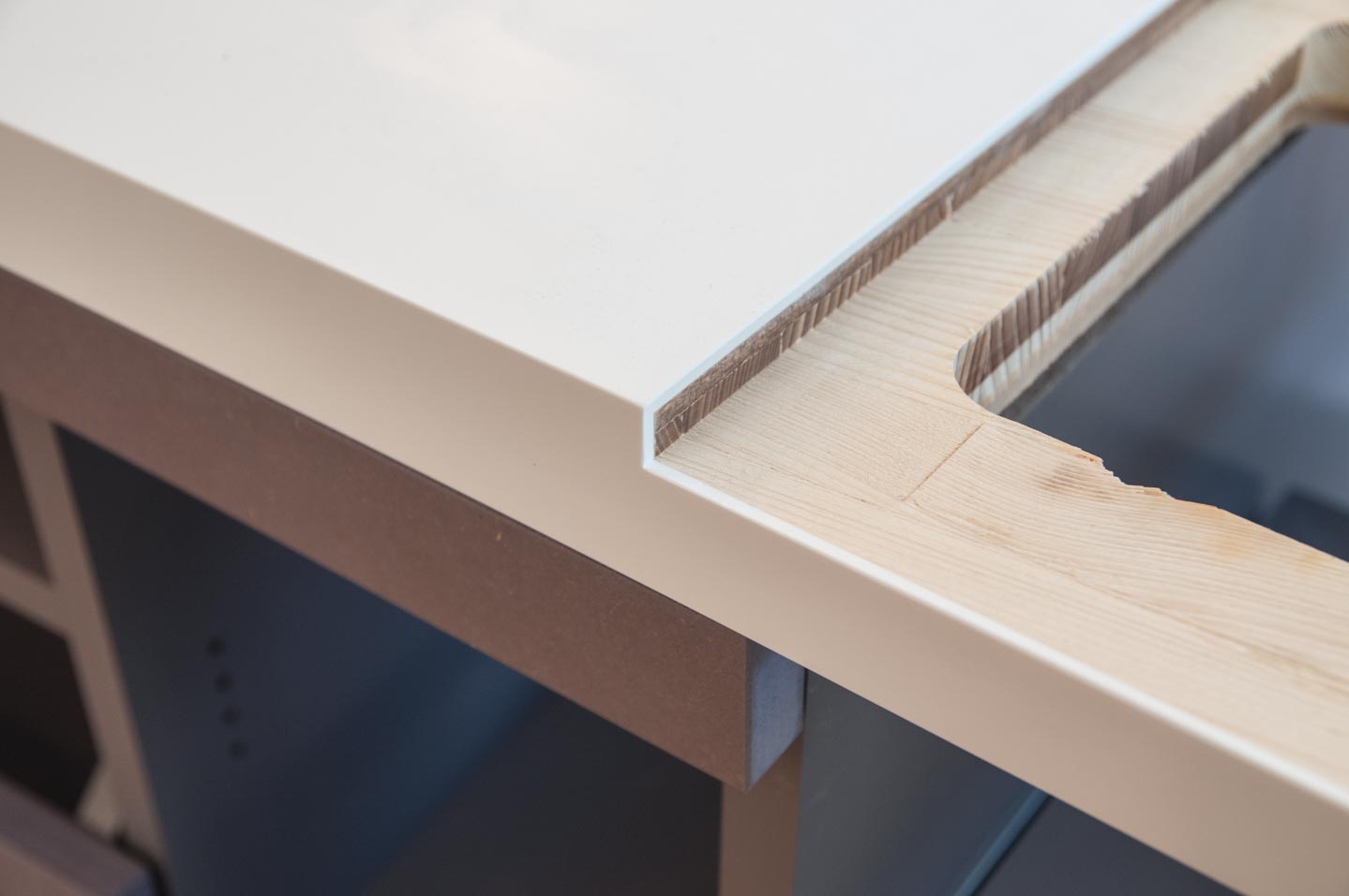
A 40 mm engineered solid timber panel is faced with 4 mm solid-surface material and bonded on site to form a seamless, nine-metre worktop. This counter should last a year or two …
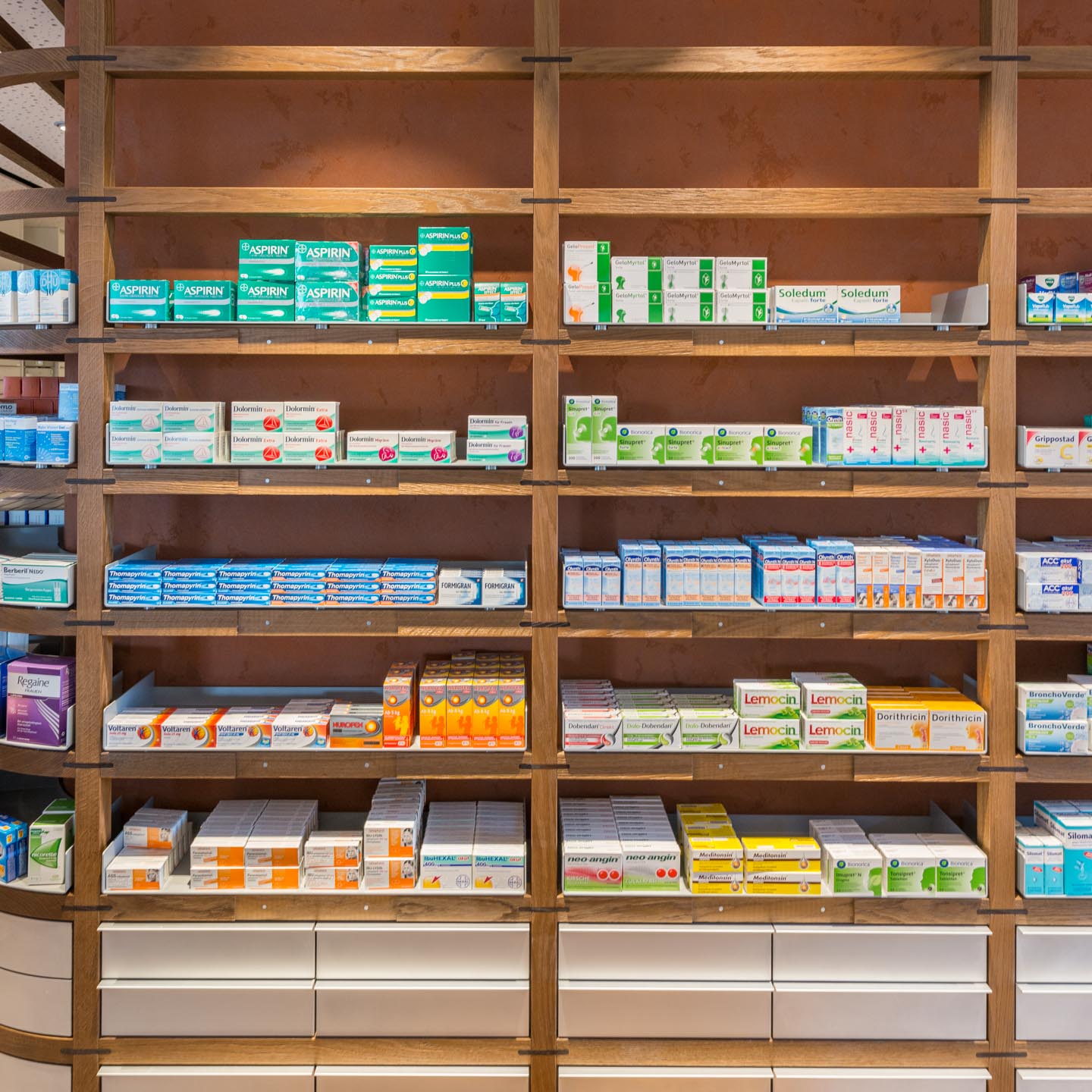
Behind-the-counter display at Rufer Pharmacy
The display behind the counter should be easy to scan and clearly organised. If you add signs for product categories, they should fit quietly into the overall design and be easy to replace. A digital display can make sense. Will the technology and support for those touchscreens still be available in ten years? Where wall space is tight, a digital display can have an advantage. Colourful animations and oversized spinning pill boxes will do very little for a poorly trained team. Much the same applies to an automated dispensing system. It gives the pharmacist more time with the customer, provided that time is put to good use. So far, digital display makers have largely tried to imitate the physical shelves. They could give people an entirely new visual experience.
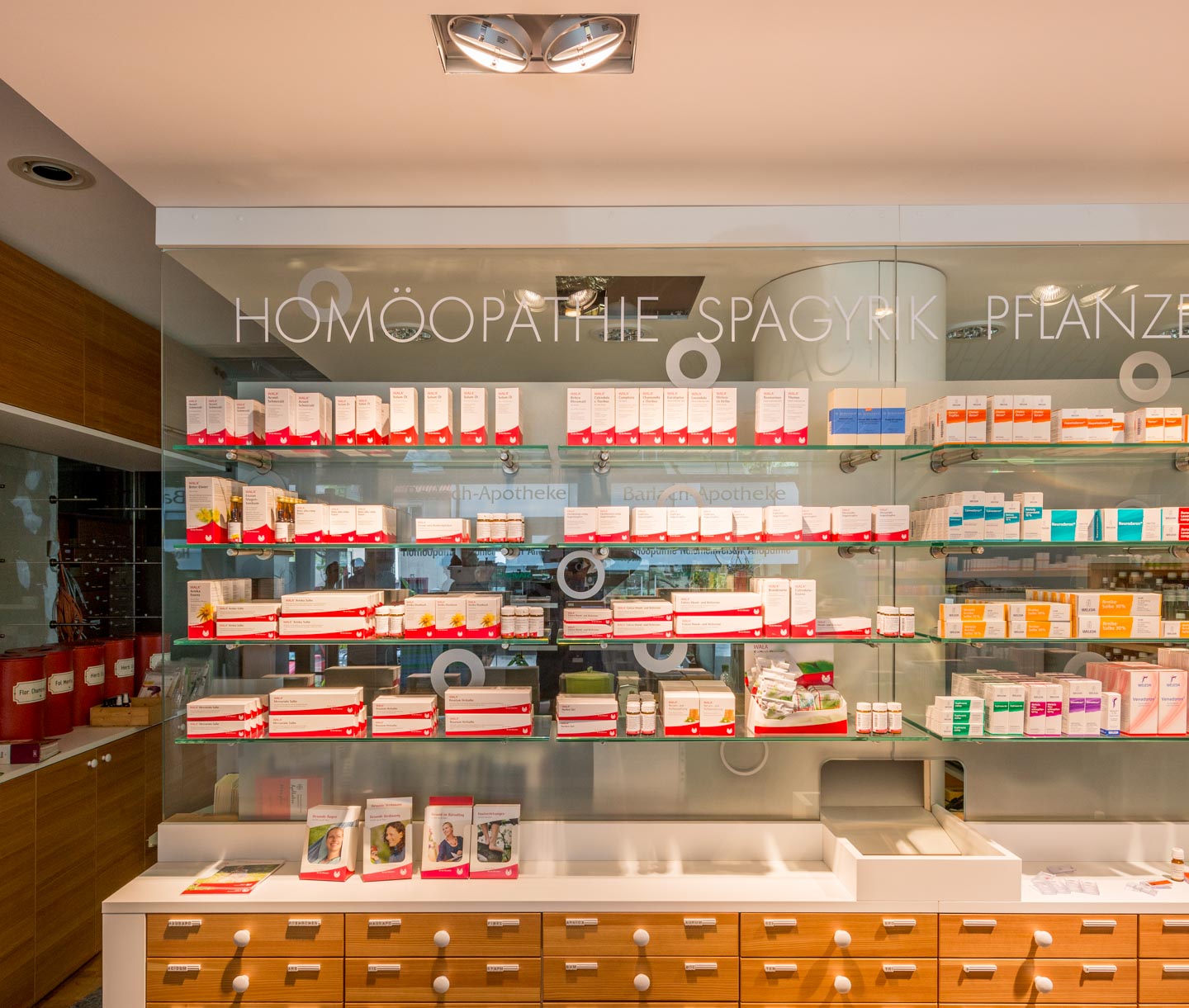
Behind-the-counter display at Barlach Pharmacy in Bad Boll
The display can also say something about the pharmacy itself. Barlach Pharmacy makes its anthroposophical approach visible. The pharmacy in Halle features a quotation from Gandhi. At Alpin Pharmacy, a panorama of the Alps photographed by the pharmacist ties the interior to its region.
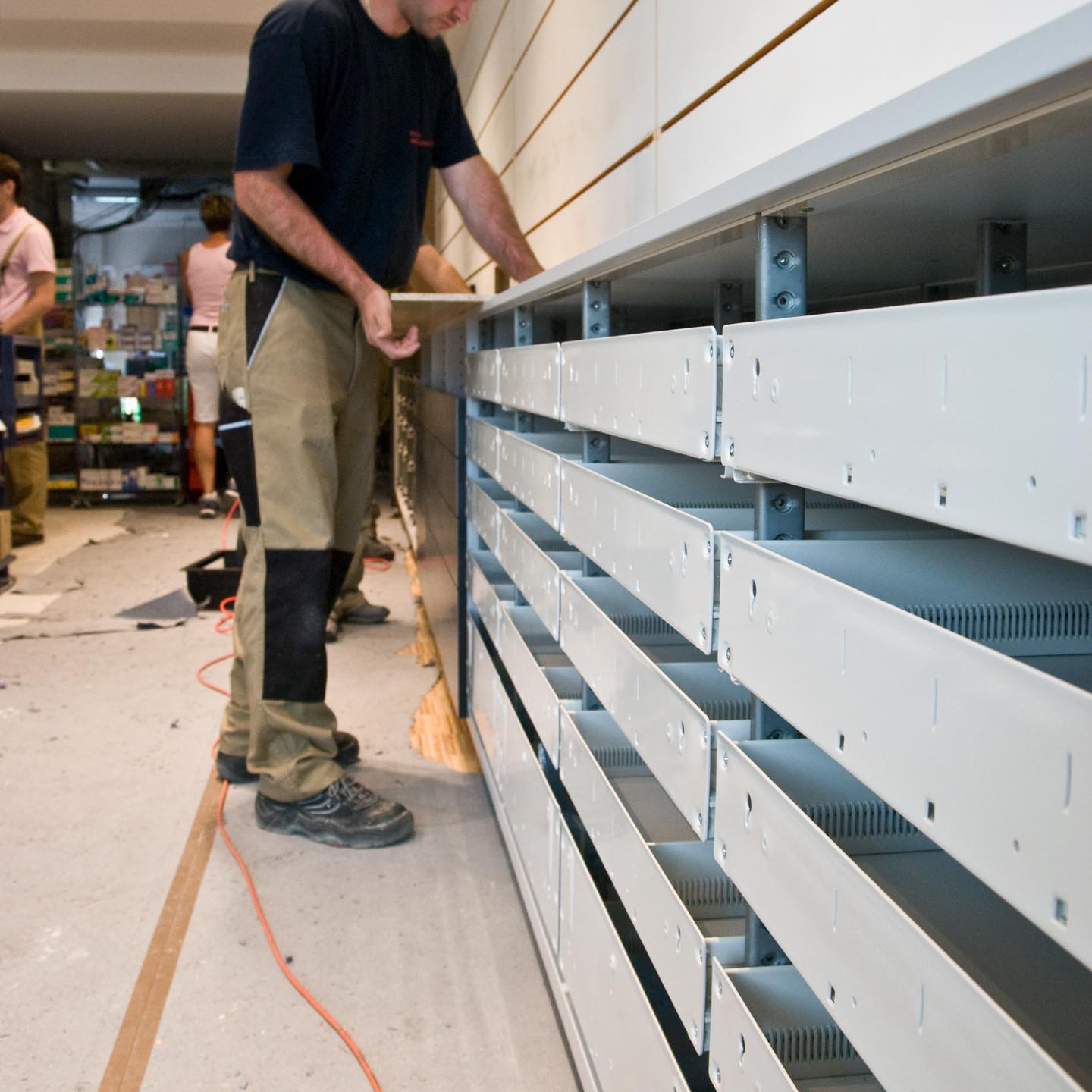
Drawer columns on site during the Fortuna Pharmacy refurbishment in Düsseldorf.
Drawers still matter when you have an automated dispensing system. We specify durable, smooth-running fittings for the dispensing counter and the drawers holding fast-moving stock.
Keep the shop windows and the public area as clear as possible, with room for customers to move.
Well-organised self-service shelving and lighting that makes products stand out are particularly helpful to older customers. Less is more here. Too much choice makes it harder to find what you came for.
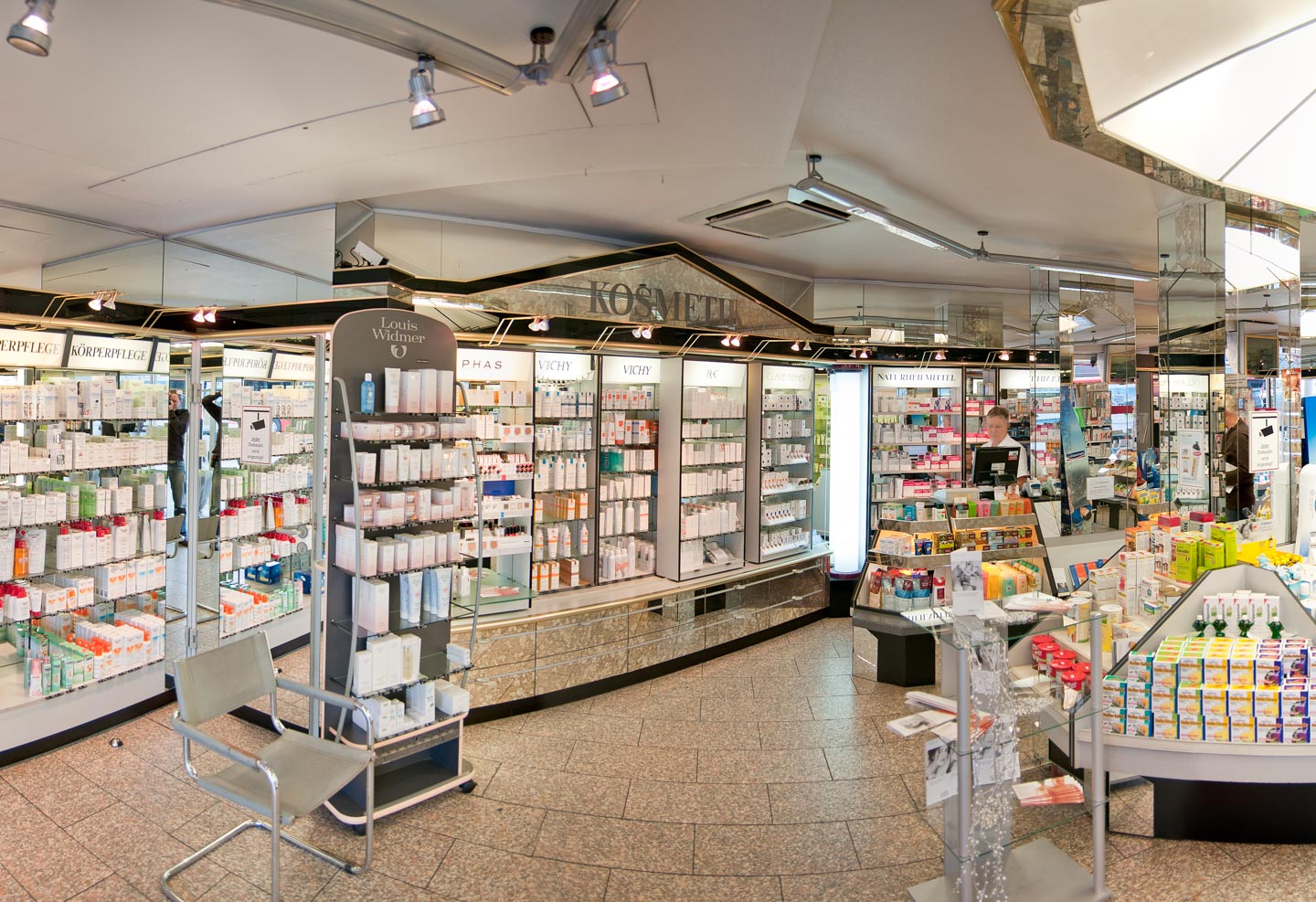
Mirrored display with low-voltage lighting
This example shows a familiar sight in pharmacies. The products themselves are neatly presented and labelled. Displaying products two rows deep gives you more space, but some of the packs will always be hidden. Mirrors make the room look bigger and double the number of boxes you see, which makes it harder to take in what is on offer. Backlit category signs compete with the light on the products, leaving too little contrast.
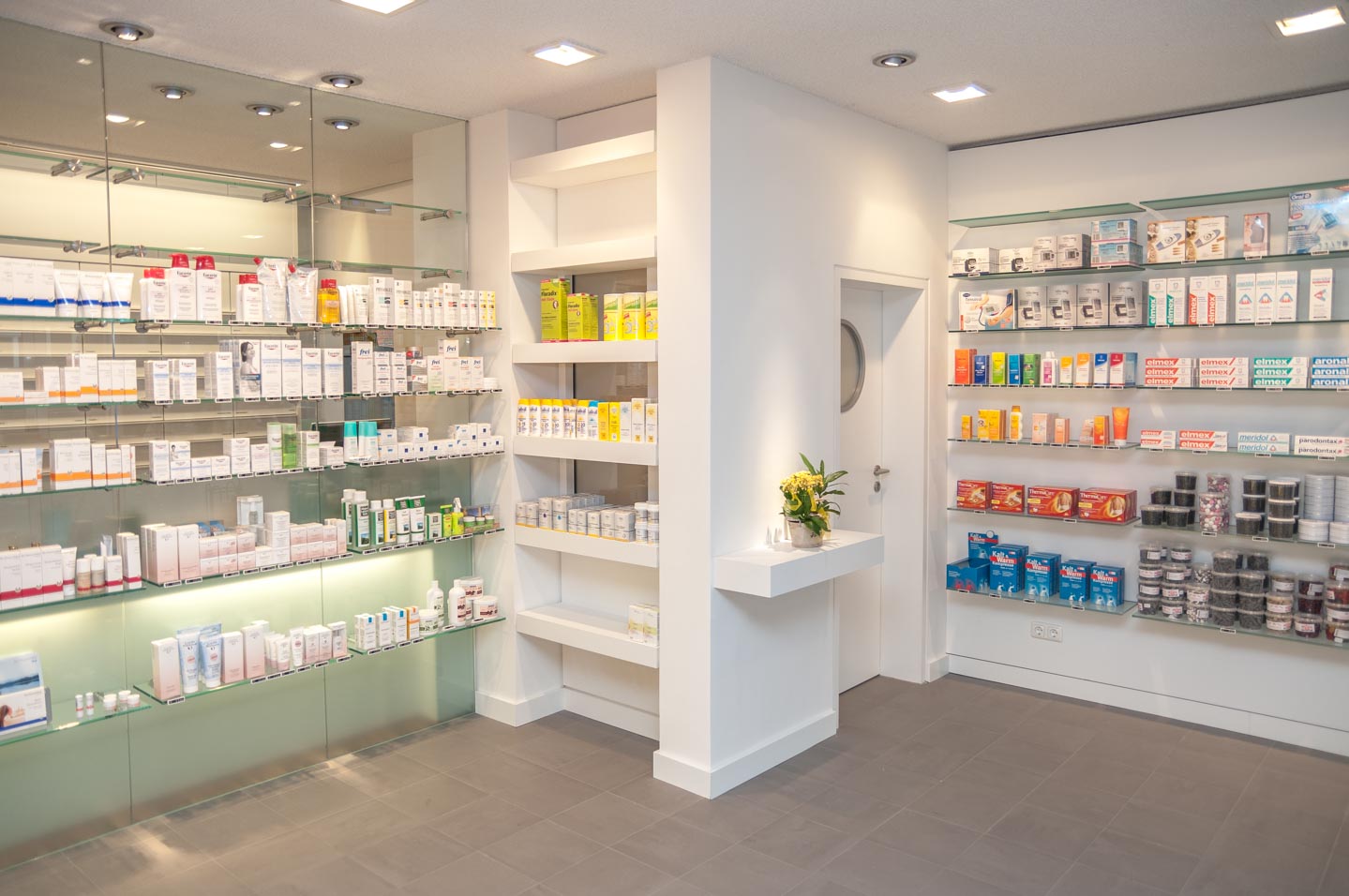
Easy to take in. The self-service shelving at Schloßapotheke in Lauenburg.
Price labels are another matter. Whether it is an acrylic strip or clips fastened to the edge of a shelf, they are usually just ugly. Finding a solution that looks good and is easy to use takes some work, but it can be done.
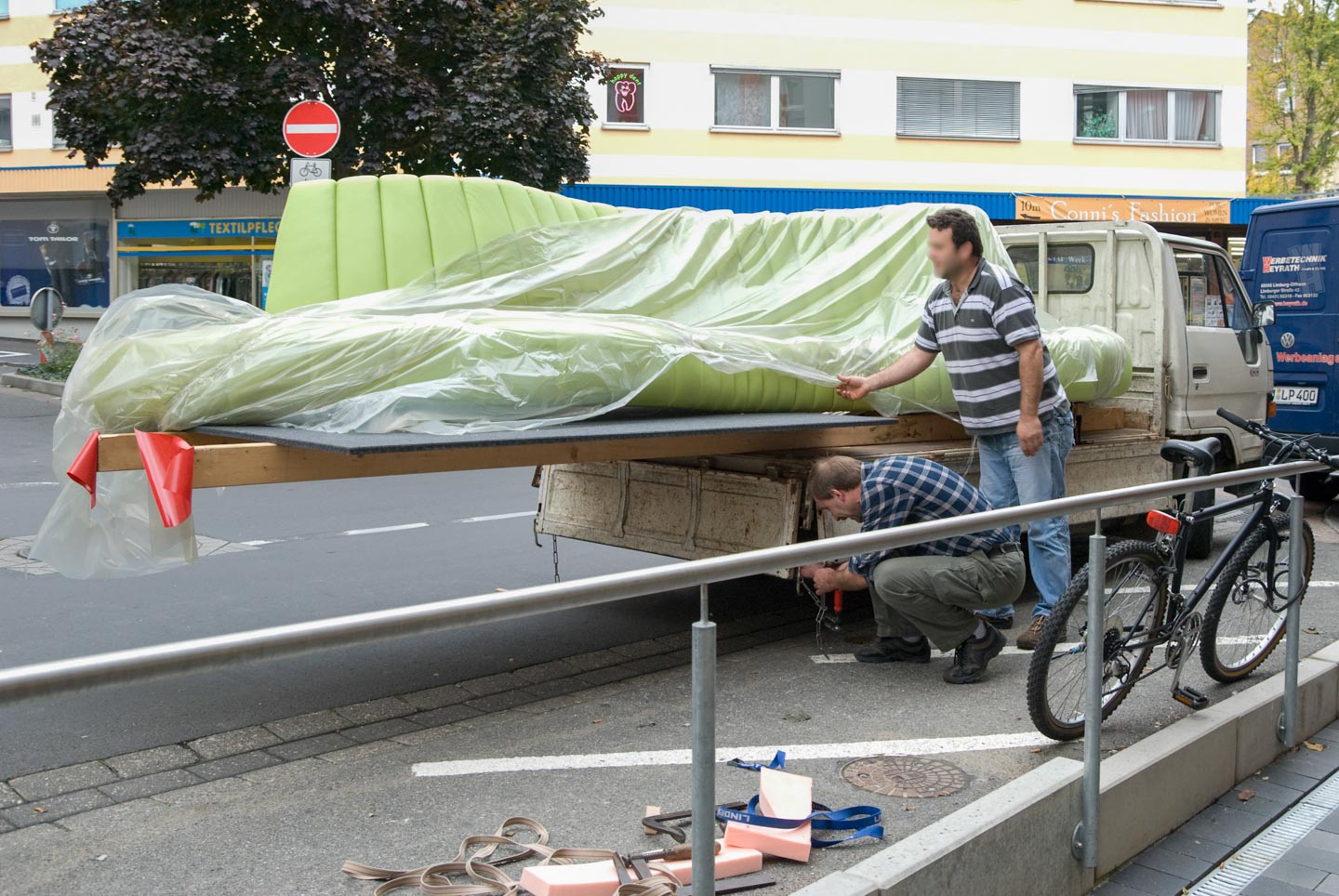
Long and green. The bench arrives at DocMorris Pharmacy in Limburg.
A place to wait belongs in a pharmacy too. Where there is room, it can become a place to linger and talk. It ought to be designed with that in mind. A water dispenser or a USB charging socket is a small gesture of hospitality.
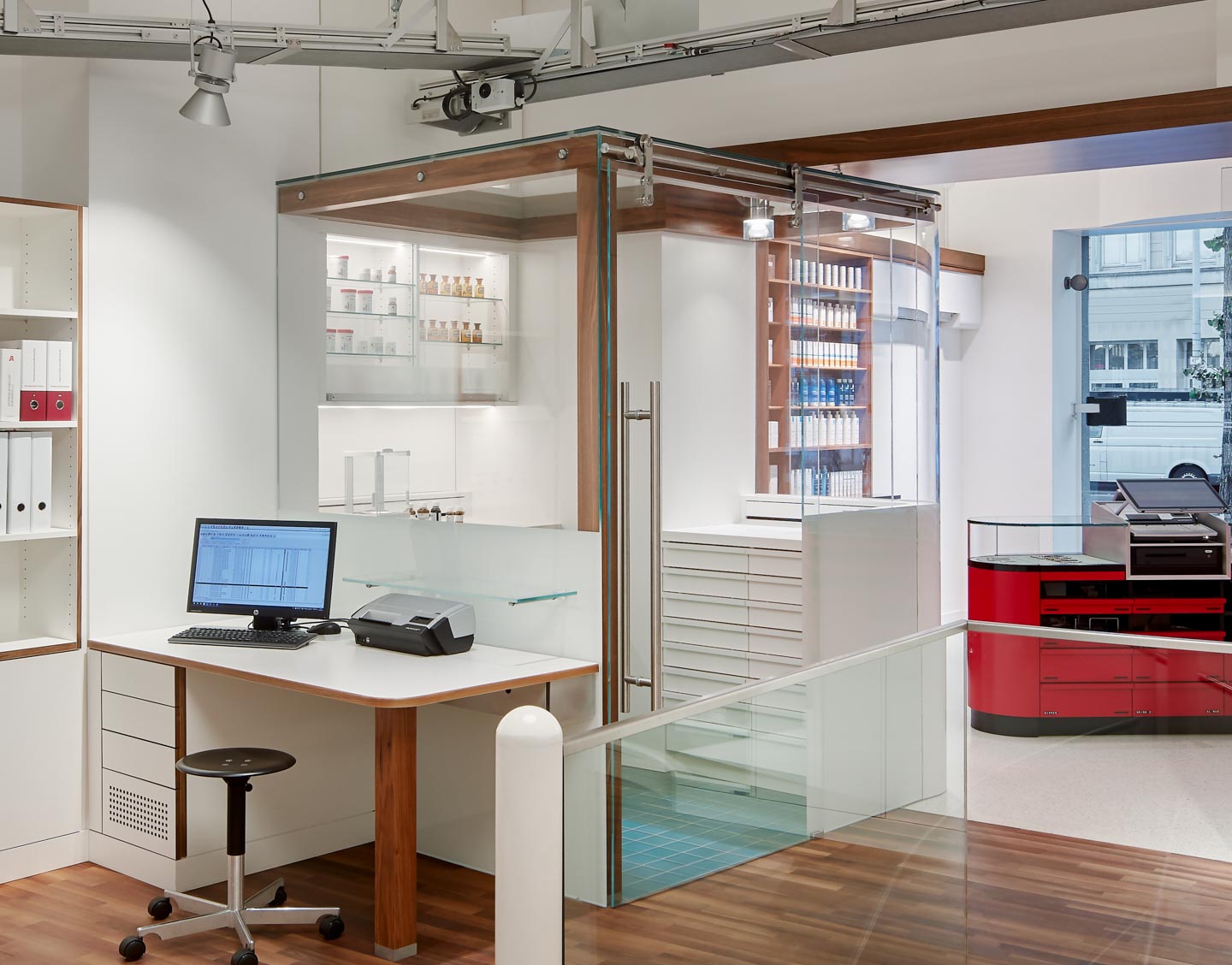
The glazed compounding laboratory at Germania Pharmacy in Aachen
A glazed compounding laboratory lets customers see the practical craft that goes into the pharmacist’s everyday work. It is a reminder of how much more a pharmacist can do than sell pills on behalf of pharmaceutical companies.
The back of the pharmacy deserves the same care as the front. A tidy work area and a layout that follows the sequence of tasks keep journeys short and easy. At busy times, the goods-in and stock areas are full of boxes. There has to be enough room to put them down and work through them. Deliveries to customers need a clear way to sort all those slips and packets. The shelves for prescriptions awaiting collection should be easy to scan, have a place for the paperwork and be within easy reach of the dispensing counter.
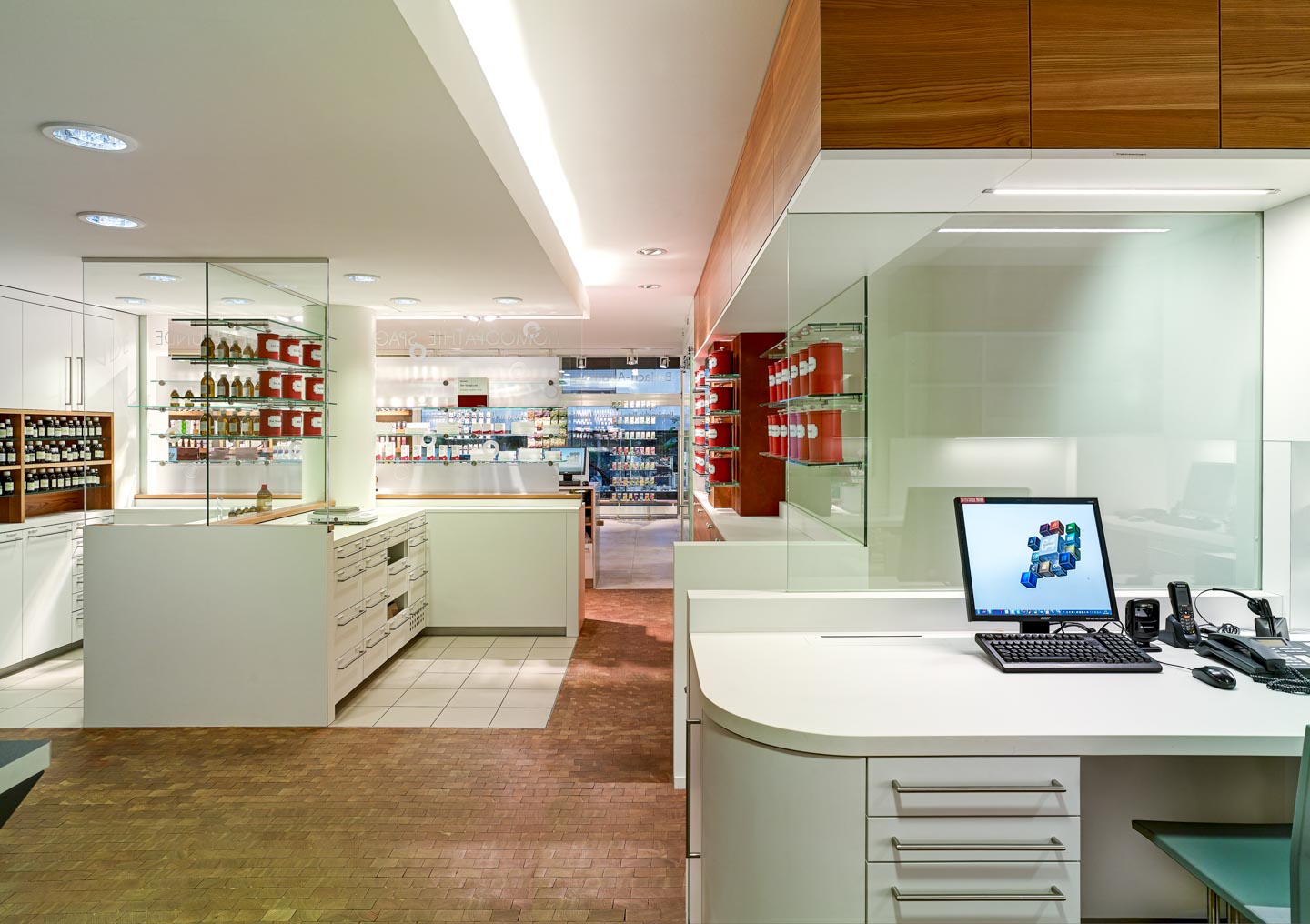
Staff work area at Barlach Pharmacy in Bad Boll
Pharmacy technicians, stock and administration staff and qualified pharmacists all need different workstations. If you spend most of the day seated, a conventional desk will do. If you have to get up constantly, a sit-stand workstation may make more sense. Assistants should have a clear view of the public area.
Small details matter too. We design the furniture to keep slips of paper and prescriptions from disappearing into gaps in or behind the units. When expensive medicines are involved, that can save a great deal of trouble.
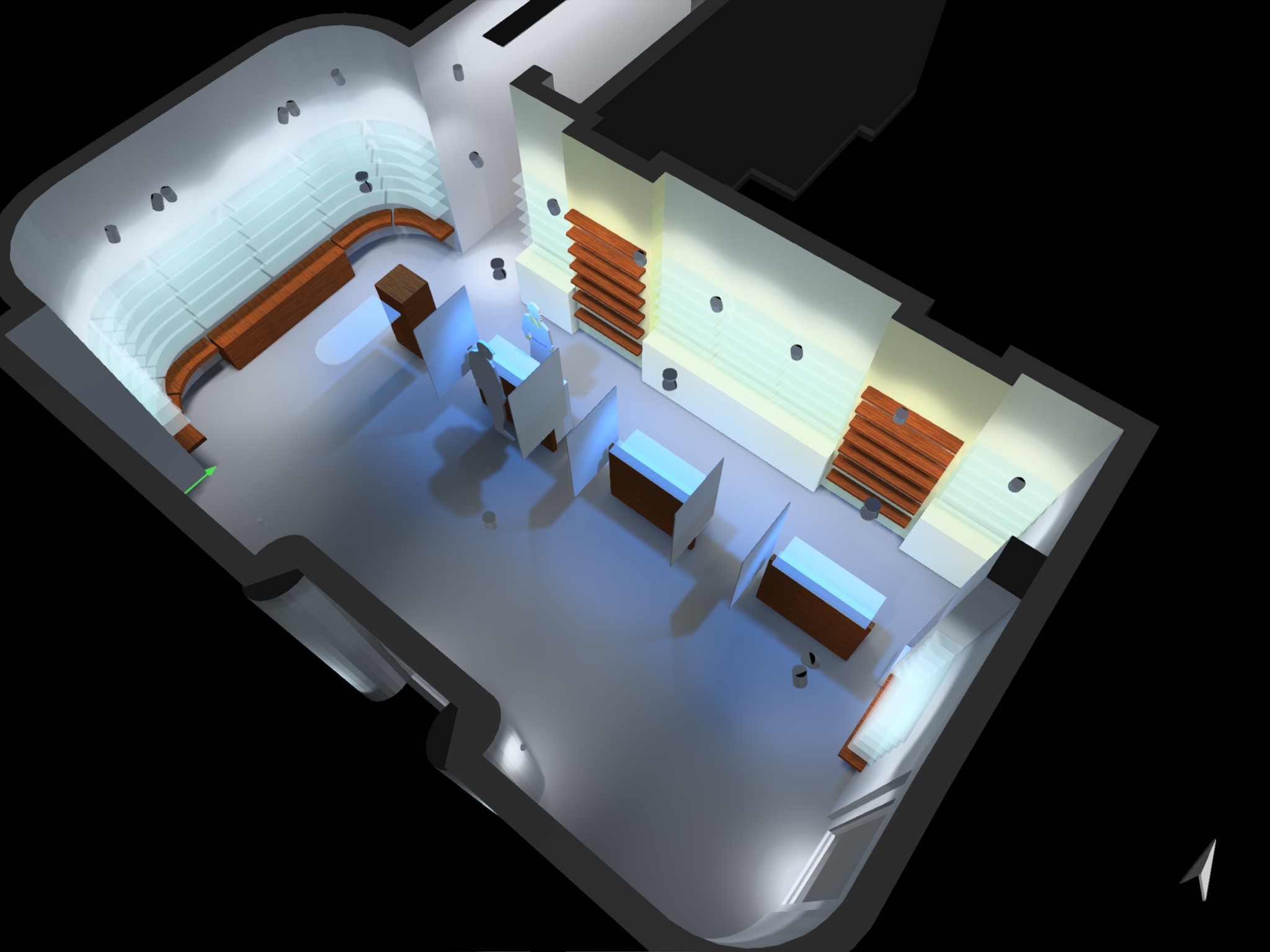
Lighting design and simulation
What role does lighting play?
Light matters even more than colour. Without it, you cannot see colour at all. There is plenty to consider and even more to get wrong. Start with the technical questions of energy efficiency, service life, colour temperature and colour rendering. For years, there was a kind of arms race in lux. “The brighter the better” was the motto. Fall behind the shop next door and your own premises looked as though they were closed.
In the days of incandescent bulbs, you paid for the electricity and then paid again to air-condition the shop in summer. Brands such as Abercrombie & Fitch and Hollister went to the opposite extreme, showing their collections in gloomy caves. It saved electricity, but it was fashionable nonsense. LEDs open up new possibilities, though they call for a little restraint. A few colour-changing effects can quickly turn the place into a cross between a Christmas market and a funfair.
Brightness and efficiency will only take you so far. If the colour rendering is poor, for example, every complexion can take on a strange reddish cast. A badly planned installation can cost two or three times as much without saving any energy.
Above all, there is the atmosphere that light creates. Fire is as deeply rooted in human life as building is. In fact, the two go hand in hand. Try recreating the romance of a campfire with fluorescent tubes. The phrase “candlelit dinner” captures it beautifully. The light source alone tells us what kind of evening to expect. It becomes a romantic occasion.
Light has a job to do as well. In the public area, it can draw customers’ eyes to particular places. And that brings us back to materials. Different colours and finishes create reflections and pools of light that can change the feeling of a room. Light cast across a surface at a shallow angle, for instance, can bring out a relief pattern.
Anyone thinking of transforming a tired interior and dim lighting into a place that encourages customers to buy, with a few LEDs and a splash of paint, may well make things worse. The interior needs to be considered as a whole. The old character will still show through a fresh coat of paint.
Colour, light and texture do much of the work of creating an atmosphere.
There is no single prescription for how to put them together.
Pharmacies are interesting because they have virtually no product of their own. Aspirin is the same in every pharmacy across Germany. It may cost a little more here or a little less there. If price is all that sets them apart, I might as well buy it online.
“I can get bad service cheaper somewhere else”
That may be true of telecoms companies. A pharmacy is a different matter. People come in because something is wrong. They may be in pain, lonely or desperate. Perhaps they have just been brushed off by their doctor. The internet cannot give them the support they need. A person can. The pharmacist in a small independent business is often the last person in that chain of care, and the one who can make a real difference. A photograph of smiling people in white coats beside sprightly pensioners on a website will never do that. That personal care is where the strength and the future of the local pharmacy lie.
About us
For the customer, the pharmacy is somewhere they spend a few minutes. For the pharmacist and their team, it is where they spend a good part of their lives. We keep both in mind when we design.
We trained as joiners before going to university. We still like materials that show their age and rooms you grow fond of over the years.
What kind of pharmacy would you look forward to unlocking every morning?
Call us on +49 2151 73 60 05.